Showing posts with label mental health. Show all posts

Monday, July 23, 2018

PSYCH INFO: ANOREXIA & BULIMIA


HEALTHY BEAUTY

Q. My daughter, age 17, is very preoccupied with her weight, hardly eats at all and is too thin. I tried to talk to her about this but she became offended and clammed up. I’m concerned she may have an eating disorder. What are the symptoms of these conditions? How are they treated? 

A. Many young women (and some men) in their teens and early twenties struggle with an eating disorder. They don’t realize that they have a serious problem which usually requires medical and psychiatric intervention. Anorexia is a serious, life threatening condition of deliberate starvation. A person who is anorexic has an obsession with being thin and an unrealistic standard of what constitutes thinness. Those who do not get help have a high mortality rate.   

Bulimia is characterized by recurring episodes of binge eating followed by self-induced vomiting or purging by laxatives, enemas or diuretics. Persons with bulimia have a fear of being fat and use the above methods to lose weight. Bulimics usually have less severe weight loss than anorexics. The bulimic feels shame about their problem and so is secretive about it.

The physical consequences of anorexia include: extreme weight loss, loss of menstrual periods, constipation, hair loss, dizziness, fainting, insomnia, kidney failure and severe electrolyte imbalances which can lead to heart attacks. 

The physical consequences of bulimia include menstrual irregularities, swollen glands, frequent weight fluctuations, chronic dehydration, kidney problems and cardiac arrhythmia. Bulimics also can have gum recession, breakdown of tooth enamel and esophageal damage from excessive vomiting. Some young people suffer from both anorexia and bulimia, an especially dangerous condition.

The psychological symptoms of anorexia and bulimia include feelings of inferiority, obsessional thoughts about food, fear of obesity, perfectionism and a distorted body image.

The media contributes to this extreme obsession with appearance and an unrealistic standard of what constitutes beauty. Recent research discovered that women who viewed advertisements of thin, beautiful women felt unhappy with their own appearance after only three minutes. Teens are especially influenced by these ads.

A former supermodel Carre Otis, who has been pictured on the cover of fashion magazines and was featured in the Sports Illustrated swimsuit issue some years ago has acknowledged her problem with anorexia. On ABC’s Primetime, she described going on a liquid fast for two weeks before each photo shoot.  Her doctors found she had three holes in her heart.

After heart surgery she began eating three meals a day instead of one. She told Primetime, “When I first started to eat food during the day it was the most terrifying thing for me. I would eat and then...cry for hours.” For seventeen years she starved herself all day and ate only a little dinner. 

Carre now weighs 155 pounds, 30 pounds over her ideal model weight. But she is still beautiful and modeling offers pour in. Carre Otis is a size 12. The average American woman wears a size 14.  Few women are meant to be as tiny as the women depicted in ads.  Carre also discovered her inner beauty when she went on a humanitarian trip to Nepal. “That’s when I felt like the most beautiful woman.”

You must get help for your daughter. She should have both a medical evaluation and psychotherapy. She must be monitored medically while working on the underlying psychological causes of the problem. Reassure her that the medical and counseling help will be offered to her with understanding, not blame.

A renewal of faith can also help anorexics and bulimics. Faith in God can help them give up their need to control and their need to be perfect, learning to place their life in God’s hands. 

“Heal me O Lord and I will be healed; save me and I will be saved, for you are the one I praise.” Jeremiah 17:14

Blessings, Dottie

Tuesday, May 1, 2018

Two Book Reviews on Health Remedies

If you’re uncertain about your doctor’s orders for medication, surgery or testing or if they don’t help, you may be interested in these two books. The second one will cure you by dealing with unconscious issues! The first book will teach you ways to improve your health by taking less medication, eliminating toxins and boosting the immune system through diet, exercise, probiotics and supplements.


Natural Remedies for Essential Tremor     

By Donna Gagnon

Natural Remedies for Essential Tremor by Donna Gagnon is chock full of information about remedies other than drugs and surgery that may offer symptom relief for those suffering from essential tremor. Gagnon supplies background information on Essential Tremor and on conventional drugs and surgery treatments and then covers a multitude of natural remedies that will help our health today including food choices and life style choices, eliminating toxins, nutritional supplements, alternate therapies and more. The book is well written and easy to understand plus it is documented with references. At the end of the book Gagnon puts it all together with a step by step plan for implementing lifestyle changes gradually. The information in this book will help all of us be healthier and hopefully will reduce or even eliminate tremors.


The Divided Mind: The Epidemic of Mindbody Disorders

By John Sarno

The Divided Mind by Dr. John Sarno is about the principles and practices of psychosomatic medicine written by a well known doctor who for decades specialized in helping people with back trouble using mindbody methods. Sarno is concerned that medical care in this country is in crisis. He says that over six million Americans suffering from fibromyalgia are being treated by specialists who don’t have a clue about what causes this disorder. The same is true for other disorders. He says there are hundreds of disorders that are psychosomatic. In spite of the prevalence of these disorders psychosomatic medicine is almost unknown today. Instead, doctors treat the symptoms.

Sarno writes the first four chapters in this book – about half of the book. He writes excellent chapters on the history of psychosomatic medicine, and the psychology and treatment of psychosomatic disorders. Case examples amplify his convictions about proper treatment for many people. His treatment involves teaching patients to at least keep an open mind to the fact that their problems are often due to underlying unconscious anger and the pain experienced by patients is to protect them from these feelings of rage. The patients who are open to this are often helped by realizing their unconscious issues and some accept a need for psychotherapy. Their unbearable pain goes away.

The second half of the book is written by six doctors who studied with Sarno and who use his methods. They support with their stories the need for an understanding of psychological needs and childhood or background issues. They include a doctor who specializes in hypertension, one who works in rehabilitation, a rheumatologist, an orthopedic surgeon, a doctor in sports medicine, and a family doctor. All of these doctors have similar stories of success with helping many people who were hopelessly sick prior to using this method. Chapter six by the orthopedic surgeon is terribly long and not well edited. The rest are excellent.

For those of us who recall seeing a family doctor in a leisurely setting in which time was not rushed and the doctor really knew you – I wish many of you could realize what we are missing today with managed care and doctors looking at their computers and doctors pushing medication or surgery for every ill. I know most doctors are caring but are trapped in the system. I hope some doctors will read this and open up their own practice to a kinder, more helpful way of treating illnesses. People need to exercise and eat right and quit most meds

“O Lord, my God, I cried out to you and you healed me.” Psalm 30:3

Blessings, Dottie


Tuesday, April 17, 2018

Psych Info: WHAT IS EMOTIONAL MATURITY?


Q. It seems to me that more and more people are emotionally immature.  We hear about road rage, child abuse and outrageous competitive behavior by parents at their children’s soccer games. What is emotional maturity and how can we instill it in our children? 

A. Emotional maturity is lacking in many people today. We are tempted to tell them to “grow up”, if only just saying this would make it happen. William C. Menninger, MD, noted psychiatrist, lists seven Criteria of Emotional Maturity. These are excellent guidelines to judge and guide our quest for maturity in ourselves, and in our children. The comments following each of these are my own understanding and thoughts.

1. The ability to deal constructively with reality. Individuals with this trait are able to face the truth about them self and to see the world realistically.  For example, when given a bad review at work they will remain rational, though inwardly in turmoil. They will attempt to understand and grow from the criticism if it is valid.
   
2. The capacity to adapt to change. Change is inevitable in life. The mature person lets go of the past and moves forward in the direction change takes them. This isn’t necessarily easy even for the mature person, depending on the significance of the change.
   
3. A relative freedom from symptoms that are produced by tensions and anxieties. The emotionally mature person is able to function in the world even though they may have some anxious or tearful times, occasional insomnia or minor physical symptoms. They go to work and do their job in spite of tension or anxiety.
   
4. The capacity to find more satisfaction in giving than receiving. Our culture encourages self-centeredness, grabbing for ourselves. Until we learn that giving is more rewarding we remain like children. When we enjoy giving we are kind, gentle and loving with others and with ourselves.
   
5. The capacity to relate to other people in a consistent manner with mutual satisfaction and helpfulness. We enjoy working and relaxing with other people and there is mutual give and take in our relationships with others. Again, we connect and enjoy friendships. We are kind, gentle and loving.
   
6. The capacity to sublimate, to direct one’s instinctive hostile energy into creative and constructive outlets. I’m not sure I would describe anger as “instinctive hostile energy” but we certainly are born with the God given capacity to get angry. The emotionally mature person has learned to control his anger so it does not do emotional or physical damage to anyone.  After his or her anger has subsided, the emotionally mature person attempts to find a rational, constructive solution to the problem. Though anger may be justified often forgiveness goes the second mile.
   
7. The capacity to love. Love is not a feeling. It’s how we behave toward others. Love is the action we take no matter how we feel. A sick child wakes us at night and we stay up and nurse the child though we certainly don’t feel like it. The apostle Paul defines love in this way: “Love is patient, love is kind. It does not envy, it does not boast, it is not proud. It is not rude, it is not self-seeking, it is not easily angered, it keeps no record of wrongs.”  Read I Corinthians 13 for Paul’s complete description of love. 
   
How can we help our children grow toward emotional maturity? Children learn from our behavior as well as from our words. If we lovingly model emotional maturity they will learn this from us. We must understand that their growth toward maturity is a slow process. We must be patient and accept their immaturity while applauding each sign that they are becoming more emotionally mature. We need to be patient with ourselves in our own growth to maturity also. No one meets these criteria perfectly or all the time.

“Joyful is the person who finds wisdom, the one who gains understanding.” Proverbs 3:13

Blessings, Dottie

Tuesday, March 13, 2018

Psycho Info: WHAT IS AN EMOTIONALLY HEALTHY PERSON?


Q. What is an emotionally healthy person? It seems to me that everyone has strange quirks in their personality, unresolved past issues, and difficult family relationships. Is anyone emotionally healthy?

A. There are a variety of criteria used by various experts to define an emotionally healthy person. Since we are all flawed human beings no one meets all these criteria 100 percent of the time. We are all works in progress. Hopefully, we’re growing in the direction of emotional health.
         
Dr. Doug Meske, psychologist, suggests we have six emotional needs and when these needs are met we function in a healthy way. These basic needs are:

1. Positive self esteem. We have positive self esteem when we know we have value just for being who we are apart from any role or accomplishment. A person with positive self esteem can think or say “I like myself.” They can be aware of their flaws yet still accept themselves for their positive qualities. 

2. A sense of accomplishment and purpose. We have a sense of accomplishment and purpose when we feel pride or satisfaction in what we do. We play many roles in life: parent, friend, daughter, spouse, employee, and so forth. We need to feel satisfied about our accomplishments in at least some of the roles we play.
         
3. A sense of security. We need to feel safe. We need inner peace. We need order, consistency and trust in daily life and in our relationships. If we have to “walk on egg shells” we are not feeling safe. A healthy person will gain this inner security from consistent, positive family relationships in childhood or from substitute positive relationships as an adult. Inner security is also gained by believing in God and trusting he is good and loving and cares for his children.

Life is unpredictable and not always under our control. The emotionally healthy person learns to cope with change and disappointment. A healthy person recognizes what can be changed in their life and what cannot. The Serenity Prayer below is a helpful resource to keep ourselves from worrying about the ways in which we are not totally secure. 

“God, grant me the serenity to accept the things I cannot change, the courage the change the things I can change, and the wisdom to know the difference.”
         
4. We need relationships. “No man is an island.” We need to have contact with friends, colleagues, family members. We need to know that someone else knows who we are and cares about us. We may enjoy time alone and at times feel lonely but we also are able to connect with others.
         
5. We need to take care of unfinished business. We may need to grow up! We have hurts, grudges or unresolved issues from our childhood, from past relationships or from past experiences. We need to look at these, address them and then let them go.  Past baggage weighs us down. We need to realize that we don’t always have to act on our feelings. We can be angry, for example, without hurting anyone. We can respond calmly and appropriately even when someone else is acting inappropriately.  
         
6. We need to be able to have fun. We need to take time to relax and enjoy life. We need to look forward to pleasurable activities. Laughter is healing and keeps us from taking ourselves too seriously. 

I would add:
7. We need God. We need to reach beyond ourselves to find meaning in life. Faith can fill a deep inner need we all have and so much more.

“God gives wisdom, knowledge and joy to those who please him.” Ecclesiastes 2:26

Blessings, Dottie


Tuesday, March 6, 2018

Two Books on Improving Your Health


If you’re reluctant to follow your doctor’s order for medication, surgery or testing you may be interested in these two books. You will learn ways to improve health by eliminating some medication, and eliminating toxins plus boosting the immune system through diet, exercise, probiotics and supplements.

Mind Over Meds: Know When Drugs are Necessary, When Alternatives are Better – and When to Let Your Body Heal on its Own

By Andrew Weil, MD

Mind Over Meds by Andrew Weil, MD, is an important book about the over use of medication and the importance of life style changes in order to improve health. Weil reports that “adverse drug reactions are the fourth leading cause of death in our country and rank between the fourth and the sixth more common cause of death in hospitalized patients.” He also says “antibiotics that we use to kill or inhibit the growth of disease-causing bacteria may alter liver and kidney function and interfere with digestion.”

Through chapter after chapter Weil gives examples of people who have been terribly over medicated, describes in detail the medical issues of over use and misuse and then explains the integrative approach using meds when needed, plus diet, exercise, supplements, and mind/body approaches to achieve health.

The medications he found most concerning are “over prescribed, mis-prescribed, over used and misused.” They include antibiotics, statins, GERD medications, antihistamines, sleep aids, steroids, anti-inflammatory drugs (aspirin and ibuprofen) and more. Even over the counter medications can have many side effects that cause more harm than help.

There is a wealth of information in this book. Most of us need to at least reduce the number of medications we take and learn from this book how to be healthier without them.

The End of Alzheimer’s: The First Program to Prevent and Reverse Cognitive Decline

By Dale E. Bredesen, MD

This is an exciting and amazing book that describes Dr. Bredesen’s careful scientific research to find a way to reverse Alzheimer’s and to also prevent the disease. His cure for Alzheimer’s is not a simple fix and many doctors will not admit cure is possible. (Your doctor may pooh, pooh it.) After studying brain abnormalities over some decades the author found that Alzheimer’s is not one disease but several. He discovered that thirty-six metabolic factors impact the brain. The way to reverse these changes requires a complex array of tests to rid the body of toxins and changes in life style. Some of the changes in my layman’s terms include eating organic food, taking vitamins and supplements, exercising daily, fasting 12-14 hours to give the digestion a rest and ridding the body of all toxins.

I learned about Dr. Bredesen’s protocol from a former neighbor whose wife in her fifties developed Alzheimer’s. To gain more understanding of this you can read my former neighbor’s blog. He writes beautifully and details his wife’s improvements since they went on the protocol in September 2017. She has improved already! See Matthew’s blog at www.savingjacquelynn.com. The book also describes this in detail and with case examples of cures.

“O Lord, my God, I cried out to you and you healed me.” Psalm 30:3

Blessings, Dottie


Friday, October 20, 2017

Psych Info: Healing Inner Wounds

Psych Info: HEALING INNER WOUNDS  

 Q. A friend of mine is seeing a counselor and she has been taught to identify her inner “wounded child,” her inner “critical parent” and her inner “adult.” This seems like a very helpful way to understand yourself. I often feel very hurt by what others say and do. Is this my “wounded child”? What do I need to do to heal this part of me? Where can I learn more about this approach?

A. There are many theories about personality and about therapeutic change. Many of these theories identify the broken part of us as the wounded child. Transactional Analysis was one of the earliest theories to do so. Dr. Eric Berne noticed that each of his patients moved in and out of various ego states. (An ego state is an identifiable system of feelings, behavior and physical reactions.) Dr. Berne identified three ego states that we all have and need: the Parent, the Adult and the Child. This is a very helpful way to identify the patterns in your own inner struggles and can help you heal your wounded child.      
         
The Parent ego state holds all the messages we have received from our parents and have internalized. This includes all the shoulds, oughts, expectations and criticisms from our parents and parent figures as well as all the nurturing messages they gave us. Thus, the parent ego state includes the “critical parent” and also the “nurturing parent.”

The Adult ego state is reason, logic. “Nothing but the facts.” It contains the facts about our day-to-day life and represents adult ways of dealing with life.
         
The Child ego state is our emotions and wants both now and through out our lives. It is the storehouse of all our past hurts and it is also the area in which we are free, spontaneous, and rebellious. Thus, the Child ego state contains both a “wounded child” and a “playful, free child.” 
         
No one has a perfect childhood. We all carry inner hurts into adulthood though we may not know this. We coped with these hurts by repressing them and they pop up later.

When we are hurt as very young children we cannot cope with our overwhelming emotions. We learn to freeze inwardly, to block out feelings, thoughts and memories, in order to survive. We are easily hurt as adults when something reminds us of a past hurt because this reservoir of pain has been tapped.
         
The wounded Parent copes by fighting. To ward off pain or ownership of problems the wounded Parent blames others. The wounded Adult has learned to flee and will avoid close relationships.
         
When we are in our whole Child we are spontaneous and playful. When we are in our whole Adult we behave as reasonable contented adults and we are interested in having meaningful intimate relationships. When we are in our whole Parent we will be very nurturing of ourselves and others.
         
Often our wounded parts are at war with each other. For example our wounded Parent may be critical of our wounded Child. You can help yourself by identifying which ego state you are in at any given time. When you become aware you are in one of your wounded ego states, tap into the whole nurturing Parent within and comfort yourself. This means no matter how childish your wounded Child is, you will comment from your nurturing Parent in a supportive, comforting way. 
         
For further ideas about healing the inner child read these classic books “I’m OK, You’re OK" by Eric Berne, M.D. and Your Inner Child of the Past by Hugh Missildine, M.D.  Counseling can also help. Resolving buried issues from the past often requires professional help.

A Christian counselor might use Transactional Analysis to help a client understand inner conflicts but would also encourage a Christian client to know God and turn to him for help and healing.

“Come unto Me all who are weary and heavy laden, and I will give you rest.” Matt. 11:28

Blessings, Dottie


Tuesday, September 19, 2017

PSYCH INFO: CHILD WITH NIGHTMARES NEEDS UNDERSTANDING

Q. My four year old daughter has occasional nightmares. She will wake up crying and calling for me. When I go to her it is obvious she is terrified by whatever she has dreamed. Sometimes she will tell part of her dream, that a tiger was chasing her, for example. (I tried to convince her there was no tiger there, but she wouldn't believe this.) Often she remembers the nightmare the next day and seems upset. What is the best way to handle her fearfulness? What causes nightmares?

A. Dreams are messages to us from our unconscious. They help us solve a problem. A nightmare is an urgent message about something troubling us. Although some people are rarely aware of dreaming, everyone dreams four or five times each night. Dreams help us integrate the big and little problems or feelings we face on a daily basis. They help us stay asleep - except when they are nightmares.

The dream or nightmare is a metaphor for some feeling or conflict we have experienced the previous day. It may have more than one meaning and may also refer to conflicts or traumas in the past. Children often have nightmares when they are angry with a parent or a parent is angry with them. Hence the tiger might represent angry feelings. 
    
A dream is a picture of our feelings. It is not logical or rational. It also is not direct. It teaches us in the same way a story does and is as creative as any story ever told. Some early American Indian tribes taught their children to share their dreams every day. The Senoi Indians of Malaysia also used dreams in their culture. They were nonviolent, had no crime, no major family disharmony, no mental illness and no police force, perhaps for this reason! They resolved their dream conflicts rather than acting them out.
    
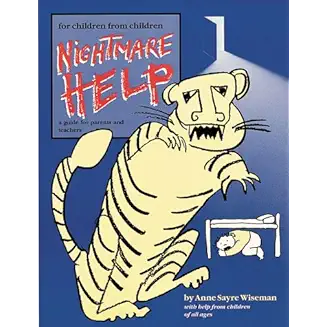
When your child has a nightmare it is important to comfort her until she is calmed down.  Respect your child's fear; don't dismiss it, ridicule it or punish it. A book titled Nightmare Help by Anne Sayre Wiseman details a fascinating approach to children's nightmares. 

She would suggest that the child ask the tiger not to come any more tonight because everyone needs their sleep. The book teaches how to help children face their fears and master them. This involves having the child draw the nightmare. Drawing it is easier for some children than telling it.  Also, details may be omitted verbally but included in a picture. Either drawing or telling someone the dream helps make the inner conflict conscious. And this leads to mastery.
    
The author emphasizes respecting the child's need to feel safe and then encouraging him or her to reenter the dream and find solutions to the problem posed in the dream. "Close your eyes and see yourself getting help. What do you see?"
    
Since there may be some stress in the parent-child relationship, your child may not be willing to work on her dream with you. The problem depicted in the dream may have to do with you! Don't press her to talk about it or to draw a picture of it if she doesn't want to do so. Also do not offer meanings for her dream. Listen carefully, instead, to any meaning she suggests. If your child has frequent nightmares and the ideas in this column or in the book don't relieve them, I recommend family counseling. Many pastors are trained in counseling or could refer you to a Christian counselor.

“All your sons shall be taught by the Lord, and great shall be the peace of your children.” Isaiah 54:13

Blessings, Dottie


Tuesday, August 22, 2017

Psych Info: DREAMS ARE SIGNIFICANT

Q. A group of my friends were discussing dreams recently and we disagreed over how often we dream, why we dream and what dreams mean. Could you write a post on dreams?

A. Everyone dreams every night; usually four to seven times. Often we don’t remember our dreams. We dream during the phase of sleep known as REM or Rapid Eye Movement sleep. During REM sleep our eyes move rapidly as though we were watching a tennis match. The REM phase of sleep occurs when we are having vivid dream images.

Studying your dreams can put you more in touch with your inner self. Dreams can point to and can even heal repressed conflicts that control the way we think and behave in our daily life. Dream books found in super markets will not help you understand your dreams and they may hinder you. Instead, consider yourself the best authority on what your dreams mean. They mean whatever you think they mean as they were created by you.

Carl Jung, pioneering psychiatrist and colleague of Freud, said: “I have no theory about dreams. I do not know how dreams arise. On the other hand, I know that if we meditate on a dream sufficiently long and thoroughly - if we take it about with us and turn it over and over - something almost always comes of it.”

Dreams come to help us. Even nightmares can show us something we weren’t aware of about our inner conflicts. Dreams also can lead to breakthroughs, pointing to solutions to problems or showing us possibilities we’ve never considered. A number of inventors and scientists have attributed their discoveries to a dream. 

Dreams are Significant                                                                           
Similarly, dreams can help us make decisions when consciously we feel stuck. They also can help us take risks and move beyond our routine ways of being. We can discover in dreams parts of ourselves we’ve denied or rejected. When we study our dreams we can heal inner splits in our personality.

Dreams can also serve as practice for future achievements. Pregnant women who dream frequently of childbirth spend less time in labor. Similarly, dreams that rehearse a perfect golf swing or an upcoming business presentation can enhance our performance.

To study your dreams you will first have to remember them. This will require determination on your part and you will need to do the following:

1. As you’re falling asleep ask God to help you remember your dreams.

2. Have paper and pencil handy so you can write down your dreams when you first wake up.

3. If possible, let yourself wake up without an alarm clock, as the noise may jar you into forgetting your dreams.

4. Write down your dreams immediately or they will fade and you won’t be able to remember them. Names or phrases in the dream can be especially revealing. Write down whatever you remember even if it’s only a very brief fragment of a dream.

5. Keep your dreams in a journal and later write down any associations you have to each dream. What does the scene in the dream remind you of?

6. During the day play around with the images in your dream. Remember it is visual and symbolic. Don’t try to understand it rationally.

7. Tell your dream to someone you trust. Just ask them to listen to it without comment.  Sharing your dreams will help you discover additional meanings to them.

The Bible is full of dreams from God to specific people. Think of the boy Samuel, the many dreams of Joseph, and Daniel. God can speak to you through your dreams if you pay attention to them. God also today is speaking to many Muslims in their dreams. For more on this see book review on Dreams and Visions here.

“I trust in you, O Lord, I say, ‘You are my God.’ My times are in your hands.” Psalm 31:14-15

Blessings, Dottie


Tuesday, July 25, 2017

Psych Info: WHAT IS THE UNCONSCIOUS?

Q. You mentioned the unconscious in one of your articles. What is the unconscious mind and how can we know about it if it is unconscious? You seemed to suggest that we can communicate with our unconscious and vice versa.

A. The unconscious is a division of our psyche or mind. Psychic material not in our immediate awareness is in our unconscious mind. When it is somewhat easily accessible it is said to be in the “pre-conscious” mind. We can perceive, think, feel, remember, decide and act, all unconsciously. Every experience of our life is stored within our unconscious mind. All we have learned, thought, felt and experienced is recorded, yet not available consciously. This enables us to remember how to drive a car without thinking about it. 

Throughout history, the complexity of human nature has been noted along with a variety of theories to explain or make sense of our nature. Freud was the first to theorize about a vast unconscious mind with warring factions creating a variety of problems for us. He discovered that slips of the tongue were often breakthrough thoughts from the unconscious mind. Similarly, being accident prone and managing to fail when on the brink of success were noted as due to unconscious feelings or desires. Our unconscious mind is some times more in charge of our behavior than our conscious mind is!
         
Someone has compared our mental functions and the contents of our minds to a landscape at night. A search light plays over the landscape. Whatever appears in the searchlight is conscious, the rest that is hidden in the darkness is unconscious. Until recently, little was known about how the brain stores our experiences or about how a memory from the past is evoked to influence our current life.

In 1951 Dr. Wilder Penfield, a neurosurgeon, made some new and exciting discoveries. During brain surgery Penfield conducted experiments on patients who were fully conscious. He used a probe and touched the temporal cortex of the brain. He found that this forced recollections from the patient’s memory. His most significant discovery was that not only were past events recorded in detail but the feelings associated with the events were recorded as well. The event and the feelings were recorded together and one could not be recalled without the other. 

Does this matter? Yes, it does. We all carry with us wounds from our past, buried in our unconscious minds. These wounds affect our daily living. They affect our marriages, the way we treat our children and they affect our self-esteem.
         
We can learn about and heal our unconscious mind by training ourselves to remember our dreams. Daily meditation and prayer can also open the door to our unconscious mind and help us face and heal our wounds. The more we become acquainted with our unconscious minds the more integrated our personalities become. 
         
Our unconscious minds are a vast resource of wisdom that can be tapped into and used. Often inventors will dream about a solution to a problem they had struggled with unsuccessfully during the day. Our unconscious minds can be used to help solve daily problems as we face them. 
         
Similarly, athletes often visualize a perfect performance while in an altered state of consciousness. We can reprogram our minds using positive images as we meditate or pray. I hope these ideas will help you learn to use the power of your unconscious mind and also the power of prayer.

“I will bless the Lord who has counseled me; indeed, my mind instructs me in the night. I have set the Lord continually before me; because he is at my right hand I will not be shaken.” Psalm 16:7-8

Blessings, Dottie


Tuesday, June 20, 2017

PSYCH INFO: wHAT IS NORMAL?

 WHAT IS NORMAL? 

Q. I have never felt I was a normal person. Other people seem to be happier, more self-confident and better organized. I wonder about what is normal because my mother was mentally ill throughout my childhood. My Christian faith has helped me and I’ve had some counseling about this but I still wonder, am I normal? Can you give me some guidelines to tell me what is normal?

A. There are two definitions of normal. We are normal when free from a mental disorder; when not paranoid, not psychotic, not schizophrenic, not psychopathic, and not neurotic. By definition also, we are normal if we behave the way most of us behave; if we conform to what society expects of us.

There is a wide range of what is normal. Two people can be very different from each other but both can still be normal. We are all crippled or neurotic or abnormal in some way yet most of us are normal in most ways. With these ideas in mind here’s my definition of a normal person:
         
It is normal to have problems, struggles and difficulties in life. Normal people have days when they feel depressed or overwhelmed or dissatisfied. Normal people are not perfect. We fail at things. We lack confidence. We make mistakes. We forget. We procrastinate. We make excuses. We do dumb things. We have flaws. 
         
A normal person is in touch with a variety of feelings and can express these feelings in appropriate ways. A normal person has feelings of anger, sadness or fear in certain situations. A normal person is neither overly dependent nor overly independent. A normal person needs attention, connection and affection from others. A normal person also enjoys time alone. A normal person is able to adapt to changes, able to cooperate, able to be flexible. A normal person is able to be assertive when appropriate; able to set limits, doesn’t tolerate abuse.
                                                                                            
A normal person has awareness of the needs of others, cares about others and gives of themselves to others. A normal person also pays attention to their own needs. A normal person spends some time at work and some time at play. A normal person is interested in life and enjoys a variety of activities.

When life is difficult a normal person does not go to extremes. Even when very upset inwardly, a normal person keeps some perspective on their life and realizes that they will survive. A normal person does not become self-destructive or suicidal, or withdrawn. A normal person does not explode with out of control anger or become paralyzed with fear. A normal person does not turn to drugs or alcohol or some other addiction to solve their problems. A normal person maintains some emotional balance even in the midst of a crisis. A normal person also will recognize when they need to ask for help from others.

In view of your background it’s no wonder you are uncertain about what is normal. Your mother’s illness prevented her from modeling what is normal and kept her from affirming your worth. I hope these ideas will give you some reassurance and help you believe in yourself. You need to stop comparing yourself to others. We are each unique. Also, when we compare our insides to others outsides we are bound to come up short. Learn to love who you are. And remind yourself that God loves you. If your doubts continue, further Christian counseling can help.

“God is love and he who abides in love abides in God and God in him.” 1 John 4:17

Blessings, Dottie


Wednesday, May 3, 2017

Psych Info: DIAGNOSING STRENGTHS

Q. I’ve heard that mental health professionals use a manual to diagnose each client. I would like to know more about this. Can you tell me what areas are evaluated using this manual and is it reliable? 

A. The Diagnostic and Statistical Manual (DSM), published by the American Psychiatric Association, was designed to provide a clear description of each diagnostic category so that clinicians and researchers could learn, communicate about and treat individuals in a consistent and effective way. The intent was to define a given disorder by listing its specific symptoms or behaviors so that it is distinguished from every other disorder. 

Though the Diagnostic Manual has been criticized in a variety of ways over some period of time, it has had great influence in the mental health field. Insurance companies and the pharmaceutical industry rely on it to monitor the appropriateness of treatment. Clinicians must use the Diagnostic Manual in order to submit insurance claims for clients.

The Diagnostic Manual includes five areas of evaluation. The first one includes all of the psychological diagnostic categories except for personality disorders. Number two includes personality disorders (in grained personality patterns such as paranoid, schizoid, narcissistic) and mental retardation. Number three lists general medical conditions which may be affecting the client’s functioning. Number four describes interpersonal and environmental factors or problems (such as job loss, marital problems). Number five is called the Global Assessment of Functioning (GAF) which is a measure of the individuals over all level of functioning. 

Mental disorders can not be as precisely diagnosed as heart conditions or cancer but the Diagnostic Manual does provide a framework, including a range of behavior or symptoms, to assist clinicians in evaluating a client’s mental and emotional functioning.

There are problems with this, however. Human nature and personality are complex, involving mind, body, spirit and emotions. It is difficult to pigeon hole or label individuals and this is often done after just a fifty minute evaluation. Also labels can change. We grow, learn and mature through out life and often our past labels no longer fit us.

It is sad when someone has been given a mental health diagnosis incorrectly but it follows them in their medical chart endlessly or when they have changed and this change is not recognized. Also, because of the need to qualify for insurance coverage, the tendency is to use the diagnosis that will give the most coverage. This can encourage giving a more severe diagnosis than necessary.

In the April 2001 issue of Social Work, Dr. Dennis Saleebey suggests another problem, the need for a sixth category detailing Diagnostic Strengths. The Global Assessment of Functioning (GAF) defines competent functioning mainly as the absence of symptoms.  In Saleebey’s suggested sixth category of Diagnostic Strengths clinicians would list the strengths of each patient. This would include skills, talents, virtues, interpersonal abilities, family support, a strong faith and so forth. 

This idea is supported by the work of Daniel Goleman in his book Emotional Intelligence in which he gives evidence that characteristics such as self-awareness, persistence, empathy, and optimism produce successful, happier and healthier lives. 

The Diagnostic Manual is an essential and valuable tool in the field of mental health.  I agree with Saleebey, however, that there is a need to include the patient’s strengths in the evaluation. Too often the mental health field focuses on what’s wrong rather than what’s positive or valuable in a person’s life or make up. 

When choosing a therapist, find one who will recognize your strengths in the midst of your symptoms and problems.  Pay attention also to your own strengths. As I said before in a prior post, choosing a therapist with a similar world view is important no matter what. This is especially true if your faith is very important to you or if you want to explore spiritual issues. To do otherwise is like trying to communicate in two different languages.  

Blessings, Dottie

“Plans go wrong for lack of advice; many counselors bring success. Proverbs 15:22 NLT