Showing posts with label depression. Show all posts

Monday, January 7, 2019

Overcoming the Winter Doldrums


Q. I dread winter. I hate driving to work in the dark and driving home in the dark. I hate being cooped up inside most evenings and weekends because it’s too cold or snowy or icy to go out. I become bored and depressed every year around the first of January. 
       
My husband and children don’t seem to mind being cooped up. They stretch out in front of the TV for entire weekends.  We can’t move to a warmer climate because our jobs and families are here. What can I do to make the winter bearable for me?

A. For most of us there is a post-holiday let down that often coincides with very wintry weather. The cold, dark days of winter are difficult for most of us. There are a number of things you can do that will help you find some enjoyment in the winter months.

1. Spend a week thinking about what you do like or enjoy about winter. Make a list and add to it as you think of things. For instance, my list would include taking brisk walks, time to relax and do nothing, the warmth of a fire in the fireplace, and the beauty of new fallen snow.

2. Once you have made your list keep it where you will see it often and focus your mind on these things whenever a negative thought about the winter creeps in and begins to depress you. Some of your depression regarding winter is due to your negative thinking about it.
       
3. What are your goals in life? What is your purpose? If you know the answers to these questions you can find things to do to move you toward your goals - even in the winter.
       
4. Use the winter months to accomplish some of the things you usually put off doing. Clean closets, put pictures in photo albums, write letters, cook special meals, play with your children letting them suggest the game or activity, invite friends over for soup and sandwiches.
       
5. Think of fun things you can do at home with your husband or family. Rent a funny movie, play board games or card games, make taffy or fudge, cuddle with your husband while he watches football.

6. Don’t be stuck in the house every evening and all weekend even if your husband and family like it that way. Find places to go. There are inexpensive or free activities many places. You can take a class that interests you. You can visit a museum. You can volunteer to help someone in need. You can be active in a church.

7. Find some alone activities that you enjoy and do them when the rest of the family is lounging by the TV. You can knit, crochet or work on crafts. You can read a good book. You can exercise indoors.
       
8. Learn to enjoy winter sports. Ice skating, sledding and skiing are available during some of our winters. When it snows, get out and build a snowman in your yard!
       
9. Do something different. This is one of the best ways to overcome boredom and depression. It sounds too simple to be true but it works. We tend to be stuck in routines of behavior that are repetitious and not spontaneous. When we do something different we step out of our rut. 
       
I hope these ideas will help you enjoy your winter. 

“Consider it all joy, when you encounter various trials, knowing that the testing of your faith produces endurance.” James 1:2-3

Blessings, Dottie


Wednesday, February 22, 2017

THREE BOOKS ON HEALTH

Here are three book reviews I wrote on books about health issues. The first book will tell you how to get younger by exercising and it may even motivate you to do so! The second book will help you learn to overcome depression, even bipolar – written by a man who was diagnosed with this. The third book will inform you about life threatening medical issues and gives valuable information

Younger Next Year: Live Strong, Fit, and Sexy – Until You’re 80 and Beyond
 by Chris Crowley & Henry S. Lodge

This book is written by a doctor and one of his patients. They alternate chapters in describing what they have learned/believe about being as healthy as possible. The main message of this book is important- aging can be reversed and delayed by exercise. This message is repeated over and over and many great ideas are presented as to how to do this, how to work exercise into your life and how to make it a habit. I learned it is important to vary the exercise, to do weight lifting as well as walking or running and that you gain more strength and benefit when you push yourself beyond your limits.

The book is very repetitive and there are many slap stick comments and ski trip stories from Crowley that may appeal to some guys but not to many women or non skiers. I also thought the mention of evolution in many of the scientific descriptions is irrelevant.

The research evidence from Lodge gave convincing proof that exercise is key to good health. For example, he tells of sedentary 70 year old men who doubled their leg strength in three months. He also says that arthritis is an inflammatory disease of sedentary societies.

Younger Next Year also includes chapters on nutrition, emotions and connecting with others. Each of these topics greatly impacts our health especially as we age. A final chapter on sex reassures readers that this can continue into old age. The book hints at the importance of “spirituality” but says it’s not within the scope of the book. Yet they use Alcoholics Anonymous as an example of the benefits of connecting. The reason AA works is the “spiritual” path the 12 Steps require. 

I’ve been a regular exerciser for decades and I am a senior citizen. I added weight lifting four years ago. I can attest to the fact that this helps. My balance is better as well as my energy and strength. As a result of reading the book I’m jacking up my workouts so I’ll be even younger next year!

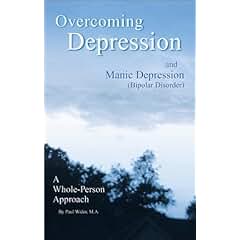
Overcoming Depression
And Manic Depression: A Whole Person Approach

By Paul Wider

Message from the author: “My heart goes out deeply to those who suffer from depression and bipolar. There is hope. It is possible to regain control of your life. I invite you to learn to master your moods using the multifaceted approach contained in this book. I wish you peace and wellness.”

Overcoming Depression is an unusual book chock full of information in a easy to read style with illustrations and steps to take for anyone who is depressed from one who has been through it. Wider was diagnosed with bipolar but refused to accept the diagnosis. He went on a quest to learn to manage his moods. The book has chapters on symptoms, causes, tools, needs, diet, faith and more. The author has used many avenues to help himself and after trial and error has many good answers.

As a retired clinical social worker and advocate for healthy life styles I’m pleased to know depression and bipolar can be successfully approached in holistic ways in cooperation with medical doctors. Mr. Wider’s book is a Godsend for those who read it and decide to try the various approaches to master their moods.

The Day I Died by Steve Sjogren

I reread The Day I Died after telling a friend about this book. She asked me if we had a Living Will and specifically wondered about water being withheld – an item on the usual Living Will. In the book Sjogren says that Terry Schiavo “died a slow and painful death due to dehydration.” He also tells of his own medical trials and says “of all the pain I experienced in life nothing comes close to the pain of being dry in the mouth for 7 to 10 days.” Sjogren describes his near death experiences of God’s reassurance and offers valuable thoughts about medical care and especially end of life care – and much more.

Steve Sjogren, former pastor of the Vineyard Community Church in Cincinnati tells a gripping true story of a simple surgery gone awry. He “died” twice during this and lives today because his wife didn’t listen to the claims that he had lost brain capacity while in a coma. She refused to pull the plug. His church and thousands of people across the country prayed for him and the prayers plus a new doctor and hospital pulled him back from the brink of death.

Much of the book describes the lessons Sjogren learned as a result of having to slow down. These are valuable lessons for all of us. His positive suggestions for what to say when visiting a dying friend are valuable. His life long daily practice of journaling and setting goals fascinated me also. This is an intriguing and valuable book.

Blessings, Dottie

“Praise the Lord, O my soul, and forget not all his benefits – who forgives all your sins and heals all your diseases.” Psalm 103:2-3


Thursday, May 19, 2016

HOW TO TURN A DOWN MOOD UP

Q.  I have days when I feel sad and depressed. When I get this way I don’t leave home and I accomplish very little. I don’t even answer my telephone. When I’m depressed I worry about myself and why I am the way I am. My self-esteem goes down and I feel like I’m in a deep pit and can’t get out. What’s wrong with me and how can I change?

A.  When we suffer a loss it is natural to be depressed and it is normal to go through a period of grieving. If there has been a major loss or trauma in your life, you will need to grieve over a period of months. See blog on normal grief here

Todays blog is not on the grieving type of depression but on normal every day bad moods. Most of us have bad days. We have days when we feel moody, sad or even out right depressed. The ways we handle our bad moods are often not effective; our solutions often add to our depression or even push us deeper into despair.
    
Diane Tice, a psychologist at Case Western Reserve University, studied over four hundred men and women, asking them how they overcame the doldrums. She discovered from this study which strategies worked and which ones did not. Try these strategies the next time you feel sad or depressed:
    
1. Socialize. The most popular method for overcoming depression was to get out with other people. So, going out to eat, to a movie, visiting with friends or family can help.
    
2. Change your thoughts. When we’re depressed we’re apt to worry more and to view things negatively. Notice and stop negative thoughts. Automatic, repetitive, negative thoughts reinforce depression. These thoughts may operate just beneath awareness. Learning to notice these thoughts is the first step in stopping them. We may think for example, “It’s all my fault,” or “I never do anything right,” or “No one likes me.”
Learn to challenge the thoughts at the core or your worry. Replace negative thoughts with positive ones. Challenge your negative thoughts.  Often we’re very critical of ourselves when we’re depressed. Talk back to these thoughts. Is it true you never do anything right? Look for evidence to disprove this. List the things you’ve done well. 
    
3. Plan fun activities to distract you from your mood. Be careful to pick an upbeat movie rather than a depressing one; a happy friend to visit rather than someone who is also depressed.  
    
4. Exercise. Take a walk, go jogging, swim or ride a bike. Again, you may need to force yourself at first. Choose a type of exercise you enjoy and begin slowly. Exercise increases brain chemicals which naturally lift our mood. Aerobic exercise is one of the most effective ways to lift us out of a mild depression. The reason exercise works is that it puts the body into a high arousal state; the opposite state it is in when we’re depressed.
    
5. Give yourself treats or pleasures that soothe. Make pleasurable moments part of every day. Studies show that small happy moments contribute to our being happy.  Take time for the things that bring you pleasure. Relax with a cup of tea and a good book, go for a walk, watch a funny movie, have lunch with a friend. The most common pleasures people use are hot baths, eating favorite foods, listening to music, shopping and hugging someone.
    
6. Accomplish something. Do something that needs to be done. Taking action will counteract thoughts of worthlessness. Clean a closet, do the dishes, write a letter. You may need to force yourself to act. Once you do, your mood will improve. When we tackle a chore we’ve avoided or complete a minor task that needs to be done we feel successful, thus lifting our mood. Similarly, getting dressed and putting on make-up can help us feel better.
    
7. Look at your situation from a different point of view. For example, it’s natural to be upset and even depressed if you’ve lost your job. But what are the advantages of having lost your job? 
    
8. Who has it worse than you? Comparing our own problems with someone who is has more troubles can quickly help us count our blessings.
    
9. Help someone else. Helping someone in need distracts us from our own problems. It takes us out of our self-centered focus. It helps us see that others have problems, too. This is a very effective way to lift depression. Throwing yourself into helping others is an almost guaranteed cure for depression.
    
10. Pray. Praise God and count your blessings. When we’re depressed we’re apt to see everything negatively. Seeking God with a grateful heart helps us notice positive things we take for granted. Thank God for the sunshine, for loved ones, for food and shelter. Tice says that prayer “works for all moods, especially depression.”

Why am I discouraged? Why so sad? I will but my hope in God! I will praise him again – my Savior and my God! Psalm 42:5

Blessings, Dottie


Monday, August 17, 2015

YOU’RE NOT HAVING A NERVOUS BREAKDOWN

Q.  I think I’m having a nervous breakdown. I’ve been depressed and nervous since my wife died a year ago. I can't sleep and I feel shaky. I force myself to go to work but I don’t accomplish as much as I did in the past. On the weekends I force myself to go out some where but most of the time I sit home and cry. I can’t get over having lost her. Am I having a nervous breakdown? Am I mentally ill? What can I do to get over this?

A. You’re not having a nervous breakdown. In fact, there is no such thing as a nervous breakdown.  Many people say, “I think I’m having a nervous breakdown,” when they feel very stressed or depressed. We are fearful and think the worst when our emotions are overwhelming. A nervous breakdown is not a legitimate medical diagnosis. It doesn’t exist in diagnostic manuals or medical text books. 

Nor are you mentally ill. When a person has a mental illness their personality is seriously disorganized and out of touch with reality. Instead, you are very much in touch with the reality of your wife’s death.
         
You are experiencing normal grief over the loss of your wife. Most of us expect to grieve for a few weeks after the loss of a loved one - until we experience a major loss ourselves. Then we learn that grieving is more painful than we imagined and takes much longer than we expected. 

Most widows and widowers face the same feelings you’re experiencing. After the loss of a loved one it’s very common to have periods of anxiety, sadness, tearfulness, anger and guilt. It is also common to have difficulty sleeping, a loss of appetite, and little energy. Some people also have physical symptoms such as stomach aches, joint pains, or headaches.

Friends have no doubt told you to keep busy, to be strong and positive, and make a new life. Their advice is sound but it’s only part of the story. Spending all your time grieving is not healthy. But denying your grief also is not healthy. Activity numbs the pain and keeps you in touch with the world but it doesn’t shorten mourning. 

If you try to deny your mixed emotions you will prolong your grief. The key to working through grief is to allow yourself to feel your pain some of the time, which you are doing. Go into your sadness and let yourself cry. Express your anger and hurt out loud to a close friend. It’s also helpful to write about loss.

Grieving may last several years. The fact that you aren't over it is normal and O.K. This doesn't mean you will be grieving all the time. Each year it lessens. However, you will experience periods of pain; days or weeks when you are again depressed after feeling better. Certain days will be more difficult than others. Anniversaries, birthdays, holidays and weekends are particularly difficult for most widows and widowers. Knowing this you can plan how you want to spend these days. A balance of activities with others and time alone to grieve is best. When your grief is strong don't avoid it, go into it. 
         
If you have no one you can talk to about your loss or if your depression isn’t gradually lessening, seek help from a counselor or a pastor. Talking about your loss will help speed up the grieving process. Medication can also help if your sleep problems are extreme and constant. A number of churches also offer a program called Grief Share which is very helpful. In this group program you will learn to understand your grief and how to handle it. And you will have support from others going through the same difficulties.

Above all else, call out to God in your sorrow and he will help you through this time of grief. Pray and read His Word daily. Abide in Him. He is a safe refuge.

“I will restore you to health and I will heal you of your wounds.” Jeremiah 30:17 NASB


Blessings, Dottie


Tuesday, September 16, 2014

DEPRESSION IN MEN

Q.  In the last year my husband has become irritable over minor things. He’s critical and blaming toward me and the kids. He blows up when driving in traffic, almost to the point of “road rage.” He also is working long hours and seems indifferent toward me and toward other members of the family. I’ve tried to talk with him about what’s bothering him but he gets angry about my attempts to understand or help him. My Mom thinks he’s depressed, but if so it sure is disguised. What do you think is the problem? And what can I do to help him?

Depression in Men is Often Disguised
Your husband may be depressed. Depression in men is often masked or hidden. Typically someone who is depressed shows this with sadness, tearfulness, fatigue, loss of energy, and feelings of worthlessness. However, these are not necessarily the symptoms of depression in men. Male depression is often not recognized because it is revealed in behavior rather than in feelings; depression in men may be disguised. This stems from the fact that boys are wired and raised to “be strong,” to not be “sissies” who cry. Since boys learn to avoid their feelings from a young age, when they become depressed they express this through their behavior. The sad feelings are there; they’re buried and avoided. But it is manly to get angry.
         
Depression Due to Loss
Loss is often the triggering factor in depression. Has your husband faced a major loss in the last few years? The loss of a parent or sibling through death or the loss of a job, an economic loss or a denied promotion can be a cause of hidden depression in men.
         
Depression Due to A Mid-Life Crisis
Many men go through a mid-life crisis which can be a form of depression. They are disappointed by life and begin to wonder, “Is this all there is?” They may be unhappy or disappointed about many areas of their life. They may feel empty inside, with a spiritual hunger for life to have more meaning.
         
Depression in men can be disguised in a number of ways. The anger and irritability you describe is often one of the common symptoms. Workaholism is another. Work stress can cause depression, but work can also be used as a way to cover up depression. The more depressed a man becomes the more he may throw himself into his work in order to numb his feelings.

The depressed man may also pull away from all close relationships. Since he wants to avoid feeling his inner sadness he avoids all feelings. He becomes cold and distant. Dr. Archibald D. Hart, in Christian Counseling Connection, says that after the male distances himself from others he searches for outward reasons for his withdrawal. This can result in a great deal of fault finding and blaming of his family. Hart goes on to say, “I wonder how many divorces are the result of unrecognized male depression.”
         
Helping Your Depressed Husband
What can you do to help your husband?
1. Insist that he talk about what’s bothering him. If you can pinpoint a major recent loss in his life encourage him to talk about the loss. For example, if he lost his father, encourage him to talk with you about his relationship with his father.
2. Listen carefully and don’t interrupt. Encourage him to continue talking by nodding your head or waiting for him to continue. Ask, “Is there more about that?” Be accepting of whatever he says is bothering him. Don’t argue or question at this point.
3. Urge him to face any problems he has revealed or that you know about.
4. Counseling and/or medication may be needed and can be very helpful. If he’s lost faith in God or views life as meaningless, talking with a pastor can help.
5. Reading Men in Midlife Crisis by Jim Conway may give you further help.

“He will call upon me and I will answer him; I will be with him in trouble, I will deliver him and honor him.” Psalm 91:15 NIV

Blessings, Dottie

This post appeared previously on Taber’s Truths.


Monday, December 19, 2011

Tears at Christmas


Many people experience depression at Christmas. Feeling depressed during the holidays is common for those who have lost a loved one during the year. Such a loss is keenly felt the first Christmas and for several years afterward. The fact that a loved one is not there cannot be ignored. Nor should it be. Allow sadness and tears to come. Each time you do so, you’re working through your grief further. Don’t dwell only on your loss, however. It’s OK to have happy, fun times during the holidays even though your loved one isn’t there.

Christmas depression is also common in dysfunctional families. Those who grew up in a home in which the holidays were chaotic may have a difficult time at Christmas until they resolve their childhood issues. It’s as though Christmas triggers an “anniversary reaction” to all the painful memories. To overcome this type of Christmas depression it’s important to face the inner pain. The root of the problem in dysfunctional families is often spiritual, so a renewal of faith and connection with a loving church group will help us grow beyond these issues.

Depression at Christmas is also common in seemingly ideal families. When this is true depression may be due to unrealistic expectations. Women often feel enormous responsibility to plan a PERFECT holiday for everyone else. We need to lower our expectations and accept the fact that no occasion is perfect.  We need to involve the whole family in the plans and chores. We need to do less so we can enjoy the holidays more. Remembering the “reason for the season” with participation in church celebrations will also help us let go of our worry and fretting.
           
Anyone with serious signs of depression such as difficulty sleeping, suicidal thoughts, and little energy, should seek professional counseling.  Brief counseling and medication can ease painful symptoms enabling you to enjoy this joyful season.

He heals the brokenhearted and binds up their wounds.” Psalm 147:3 NAB

Blessings,

Dottie

Wednesday, December 8, 2010

Christmas Depression

Many people are depressed during the holidays. Some are depressed due to losses through death or divorce. The holidays carry memories of former happy times and this highlights loss. Some are depressed due to financial pressure or job loss. This is increased by the desire to spend on gifts for loved ones. A variety of family tensions - marital problems, alcoholism, step family issues, adolescent rebellion - also can cause holiday depression.

These are difficult issues any time of the year but are even more difficult at Christmas because we expect the holidays to be joyful and happy. Unfortunately our life problems continue even during the holidays.

Five solutions to Christmas depression come to mind:

1. Acknowledge your feelings of loss and grief; allow yourself to cry and grieve or feel anger. Talk out feelings with a trusted friend or write about them.

2. Don’t dwell on the negative. Stop feeling sorry for yourself. Don’t grieve endlessly. Get out and do something to take your mind off your self and your problems.

3. Count your blessings. Focus on the positive. Make a list every day during the holidays of five things you’re grateful for. See the holiday time as half full, not half empty. Remind yourself that no one has a perfect life.

4. Return to your faith. Take a step or two back to God through prayer, reading Scripture, and returning to church. There are many inspiring and fun Christmas activities in most churches during the Christmas season.

5. Counseling can help with depression. If you’re having suicidal thoughts counseling is a must. If your appetite or sleep patterns are affected, medication can help. I hope these ideas will help you have a meaningful and joyful Christmas.

"Cast all your cares on him because he cares for you." 1 Peter 5:7

Blessings, Dottie