Showing posts with label conflict in marriage. Show all posts

Tuesday, July 17, 2012

What is the "Blame Game"?


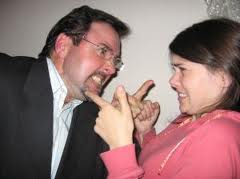
Many couples play the "blame game." For example the husband may "blame" his wife for not having the house clean. She retaliates by "blaming" him for not spending time with the children and for not earning enough money. And the "fight" escalates. This is typical of what happens when we blame or criticize others.
     
We blame others when we are angry or hurt or feel criticized for something ourselves.  The person we blame often becomes defensive or retaliates with a criticism. For many of us blame is our first line of defense against attack. Animals attack when their territory is threatened or invaded. Similarly, we humans attack when we think our "territory" is in danger. The problem is, our territory is much more complicated than the simple geographic territory of animals. 
     
We may blame others when we're tried or stressed or when they don't live up to our expectations or do things our way.  In the example above the wife did not keep the house as clean as her husband expected.  We also blame others when underneath we are hurting. For example, the criticism of the wife in the example above may have come at the end of the day, just as the husband returned from work. I wonder what he brought home with him. Did someone at work criticize him?

In order to stop the blame game you will need to make a firm decision to do so. This will involve catching yourself whenever you become critical of your partner and checking inwardly to find out what you're feeling, thinking or expecting. It will take practice and determination to change.
     
Think about the reasons for your reactions. At times you will recognize that your criticism or anger is a childish response that stems from old issues having nothing to do with your partner. Or you will realize that your anger comes from current issues that have nothing to do with your partner. You may also realize that what the other person did was accidental. Occasionally you will need to confront your partner. It's best to postpone this to a time when you both are alone and rested. Some times you will decide to tell your partner right on the spot. 
     
When you think it is appropriate to confront, use "I" statements and acknowledge your own feelings or thoughts. For example, "I'm very angry that the house isn't clean because I thought you had agreed to have it ready for my meeting here tonight." Listen carefully to your partner’s response. If he or she becomes defensive don't get drawn into blaming. Instead, focus on solving the immediate problem of how to get the house ready for your meeting.

“Stop criticizing others, or it will come back on you.” Luke 6:37 NLT

Blessings, Dottie

Tuesday, July 3, 2012

Is A Battle of the Sexes Inevitable?


Couples often engage in a classic battle of the sexes. This is a fight over the ways in which men and women are basically different. Gender differences are usually part of the core conflicts all couples experience. Our society in recent decades has escalated the battle of the sexes. Some confusion and mistrust was inevitable and necessary in order to achieve greater equality for women. However, the anger and mistrust between the sexes now often reaches the point of open warfare in which no one wins.

Women lament “Why can’t a man be more like a woman?” Men echo the cry with “Why can’t a woman be more like a man?” Gender differences are here to stay. They are real and they will not change. Roles or stereotypes may change but true gender differences will not. Some of these differences are physical, including the differences in reproductive organs. Men are also about ten percent taller than women; they have more muscle and therefore more physical strength. Women have joints that are more flexible; more body fat and a longer life span.
     
There are also developmental differences. Girls sit, crawl, walk and talk earlier than boys. Girl infants are more sensitive to touch, smell and sound. Boys in contrast are ahead of girls in visual/spatial ability.

In men brain development is localized in the left hemisphere where logic and reasoning take place. Women are born with more connection between their right and left brains.  As a result they are more adept at the right brain functions of communication, intuition and expression of feelings.
     
Studies show that from a very young age boys are attracted to objects and girls are attracted to people. Boys play competitively and girls cooperatively. From early childhood on the male views all interactions as ones in which he is either one-up or one-down. Boys learn to protect themselves from others and to fight to keep their independence. Girls, in contrast view the world in terms of connections. They seek closeness and support in their interactions.
     
Communication for most men is to give information or to solve a problem. Contrast this with women’s view of communication as a means of connecting and a way to share feelings. Conflicts occur in marriages often because of these different views of the world and different ways of communicating.
     
To resolve conflicts in a marriage both partners must reach a startling realization: Your partner is not you. We have tunnel vision. We find it hard to accept the fact that our partner sees things differently and that his or her viewpoint is legitimate. To understand and reach each other we must validate each other’s view of the world. We must see our partner’s logic as equal to ours. This is difficult as it involves giving up our self-centered point of view and making room for other perspectives.

“Each one of you also must love his wife as he loves himself, and the wife must respect  her husband.” Proverbs 5:33 NIV

Blessings, Dottie